
Episode 3 of the series Italian Present Tense
Essere and avere: the two Italian verbs you need most
4 min read

Essere (to be) and avere (to have) are the two most used verbs in Italian. You'll hear them in almost every sentence, and later you'll need both to talk about the past. They're also irregular, so the drop-the-ending method from episodes 1 and 2 won't help here: you learn them by heart.
In this lesson you'll learn both verbs in full, what each one is for, the handful of places where English leads you astray (Italians are never hungry, they have hunger), and the phrases c'è and ci sono.
Essere: to be
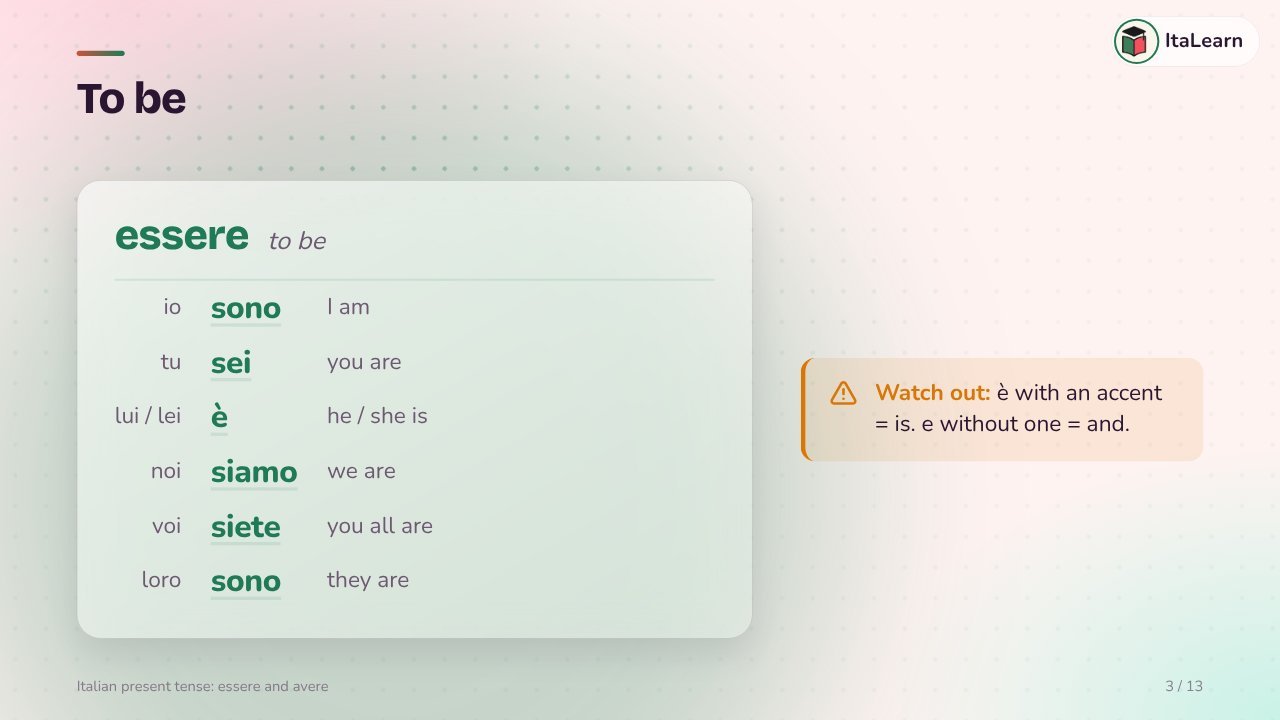
| Person | Italian | English |
|---|---|---|
| io | sono | I am |
| tu | sei | you are |
| lui / lei | è | he / she is |
| noi | siamo | we are |
| voi | siete | you all are |
| loro | sono | they are |
Two things to notice:
- Sono means both "I am" and "they are". The rest of the sentence tells you which.
- Watch the accent: è (with an accent) means "is", while e (without) means "and". Marco è alto e simpatico: Marco is tall and nice.
What essere is for
Essere has four big jobs:
- Who you are: your name or your job. Sono Anna. (I'm Anna.) Sono insegnante. (I'm a teacher.)
- Where you're from: essere di + city. Sono di Roma. (I'm from Rome.)
- What someone or something is like: Lei è stanca. (She's tired.) Il caffè è buono. (The coffee is good.)
- Where something is: Il bagno è a destra. (The bathroom is on the right.)
Notice that Italian doesn't need the word "a" before a job: sono insegnante, not sono un insegnante.
Avere: to have
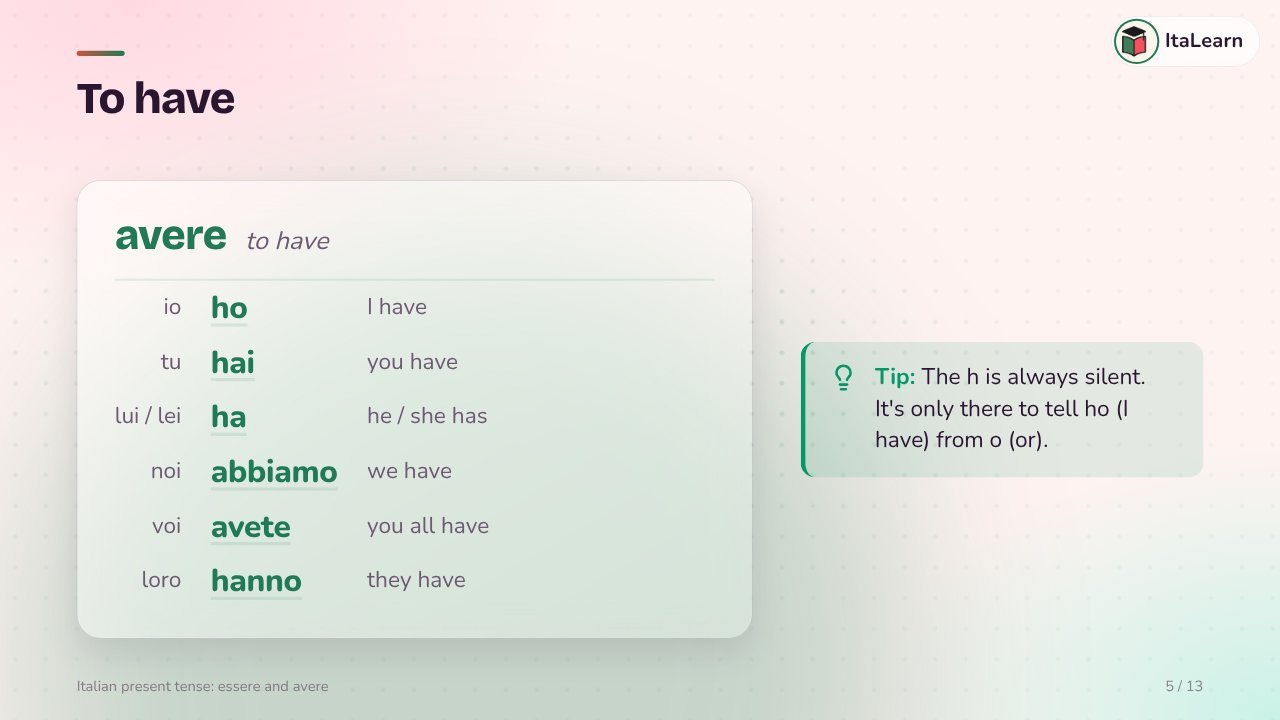
| Person | Italian | English |
|---|---|---|
| io | ho | I have |
| tu | hai | you have |
| lui / lei | ha | he / she has |
| noi | abbiamo | we have |
| voi | avete | you all have |
| loro | hanno | they have |
The h is always silent: ho sounds like "o", hanno like "anno". It's only there on paper, to tell ho (I have) apart from o (or), ha (has) from a (to), and hanno (they have) from anno (year).
What avere is for
Much of the time, avere works just like English "to have":
- Things you own: Ho una macchina. (I have a car.)
- Family and friends: Ho due fratelli. (I have two brothers.)
But here is the first surprise: your age. In Italian you don't say "I am thirty", you say "I have thirty years": Ho trent'anni. To ask someone's age: Quanti anni hai? (How old are you?)
When English says "I am", Italian says "I have"
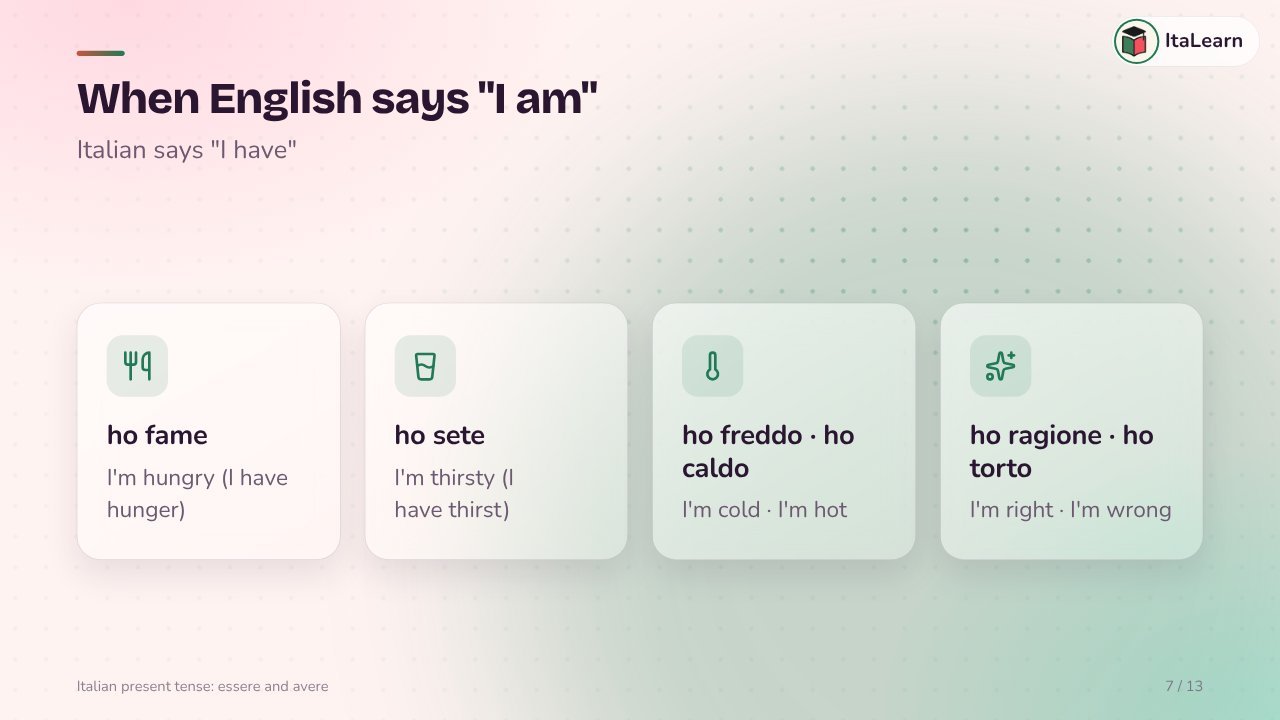
Many physical feelings and states that English describes with "to be" use avere in Italian:
| Italian | Literally | English |
|---|---|---|
| ho fame | I have hunger | I'm hungry |
| ho sete | I have thirst | I'm thirsty |
| ho freddo / ho caldo | I have cold / heat | I'm cold / hot |
| ho ragione / ho torto | I have reason / wrong | I'm right / wrong |
| ho sonno | I have sleep | I'm sleepy |
| ho paura | I have fear | I'm scared |
| ho fretta | I have hurry | I'm in a hurry |
To ask a friend, just switch to the tu form: Hai fame? (Are you hungry?) Hai freddo? (Are you cold?)
A small pronunciation trap: ho sonno (I'm sleepy) has a double n, held a little longer. Sono, with one n, means "I am".
There is, there are: c'è and ci sono
Essere also gives you two phrases you'll use constantly when travelling:
| One thing | More than one |
|---|---|
| C'è un bar qui vicino. There's a bar nearby. | Ci sono due bar. There are two bars. |
| C'è un problema. There's a problem. | Ci sono molti turisti. There are lots of tourists. |
C'è is short for ci è. To turn either into a question, keep the same words and raise your voice at the end: C'è un bar qui vicino? (Is there a bar nearby?)
Common mistakes from English
Translating word for word from English produces three classic mistakes:
| Word for word (wrong) | What Italians say |
|---|---|
| Ho fame. (I'm hungry.) | |
| Ho trent'anni. (I'm thirty.) | |
| C'è un bar qui? (Is there a bar here?) |
If it's hunger, thirst, temperature, sleepiness or age, reach for avere. If you're asking whether something exists somewhere, use c'è or ci sono.
Practice
Fill in the gap with the right form of essere or avere (or c'è / ci sono):
- Io ___ di Milano. (I'm from Milan.)
- Noi ___ fame. (We're hungry.)
- ___ un problema? (Is there a problem?)
- Tu ___ stanco? (Are you tired?)
- Loro ___ ragione. (They're right.)
- Ci ___ tre musei. (There are three museums.)
Answers: 1. sono 2. abbiamo 3. C'è 4. sei 5. hanno 6. sono
Next
Next episode: the top irregular verbs you'll use every day, andare, venire, fare, volere, potere and dovere. Find every lesson on the Italian Present Tense series page.