
Episode 4 of the series Italian Present Tense
Italian irregular verbs: andare, venire, fare, volere, potere, dovere
5 min read

This is the last episode of Italian Present Tense. After regular verbs and essere and avere, it's time for six irregular verbs you'll hear in almost every conversation: andare (to go), venire (to come), fare (to do, to make), volere (to want), potere (can) and dovere (must).
By the end, you'll be able to say where you're going, what you want and what you have to do, and you'll know the two phrases that make you sound polite at any Italian bar.
Why these six?
They're irregular: the stem changes, so the method from episodes 1 and 2 doesn't work and you learn the forms by heart. Three of them (volere, potere, dovere) team up with a second verb, which makes them incredibly useful. And here's some good news: the voi form (you all) is regular in all six.
andare: to go
| andare | ||
|---|---|---|
| io | vado | I go |
| tu | vai | you go |
| lui / lei | va | he / she goes |
| noi | andiamo | we go |
| voi | andate | you all go |
| loro | vanno | they go |
Four forms start with v; only noi and voi keep the original stem. For cities use a, for countries use in: vado a Roma (I'm going to Rome), vado in Italia (I'm going to Italy).
Three phrases you'll use all the time:
- Vado a casa. I'm going home.
- Andiamo al mare! Let's go to the beach! (The noi form doubles as "let's".)
- Come va? How's it going? (Literally: how does it go?)
venire: to come
| venire | ||
|---|---|---|
| io | vengo | I come |
| tu | vieni | you come |
| lui / lei | viene | he / she comes |
| noi | veniamo | we come |
| voi | venite | you all come |
| loro | vengono | they come |
A g sneaks into io and loro: vengo, vengono. To invite someone: Vieni con me? (Are you coming with me?)
Going or coming?
Think about direction. Andare is moving away, to some other place. Venire is moving toward the person speaking, or joining them.
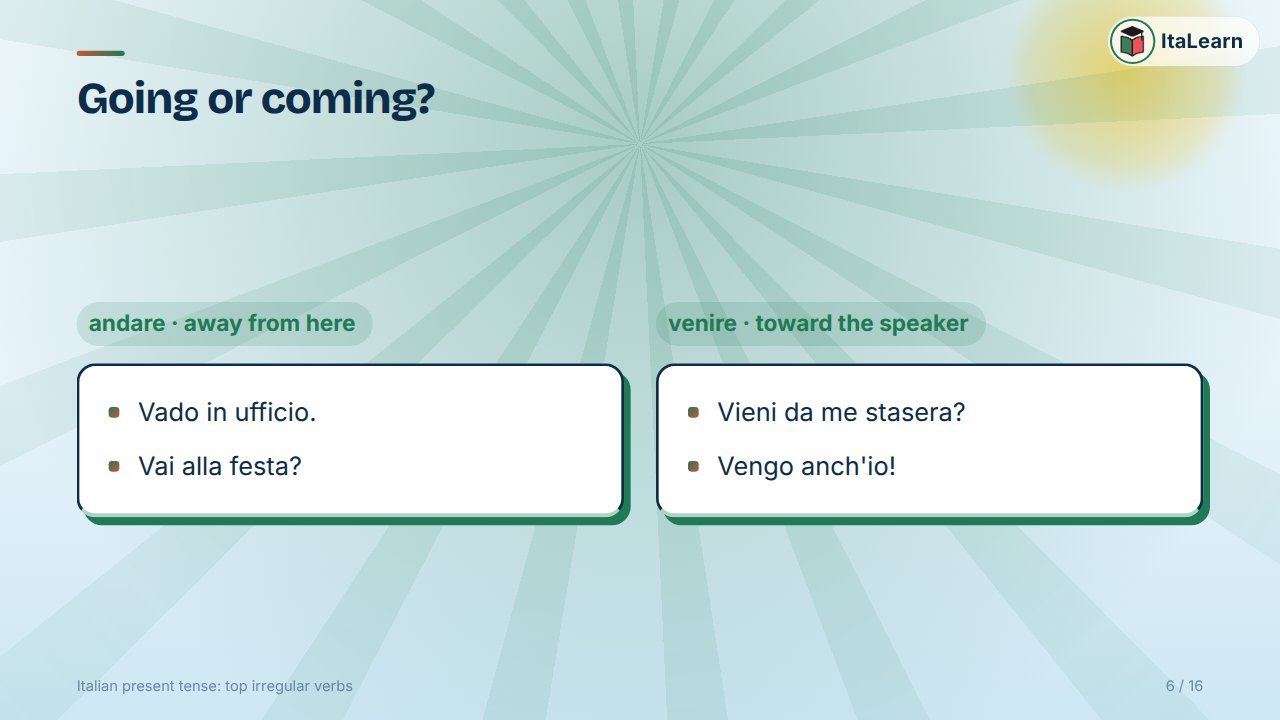
- Vado in ufficio. I'm going to the office.
- Vai alla festa? Are you going to the party?
- Vieni da me stasera? Are you coming to my place tonight?
- Vengo anch'io! I'm coming too!
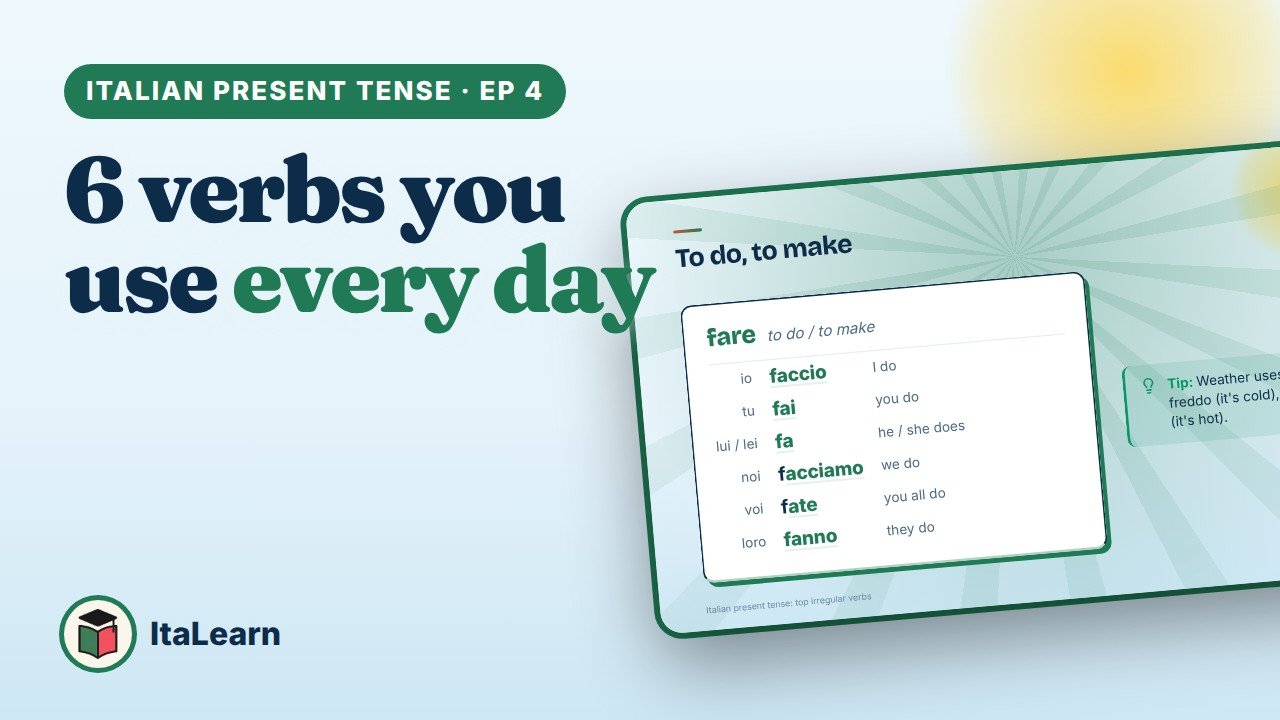
fare: to do, to make
| fare | ||
|---|---|---|
| io | faccio | I do |
| tu | fai | you do |
| lui / lei | fa | he / she does |
| noi | facciamo | we do |
| voi | fate | you all do |
| loro | fanno | they do |
Fare is the busiest verb in Italian. It even does the weather: fa freddo (it's cold), fa caldo (it's hot). And where English "has" or "takes", Italian often just "does":
| Italian | English |
|---|---|
| fare colazione | to have breakfast |
| fare la spesa | to do the food shopping |
| fare una foto | to take a photo |
| fare la doccia | to take a shower |
volere, potere, dovere
These three are the most powerful verbs in the episode.
| volere (want) | potere (can) | dovere (must) | |
|---|---|---|---|
| io | voglio | posso | devo |
| tu | vuoi | puoi | devi |
| lui / lei | vuole | può | deve |
| noi | vogliamo | possiamo | dobbiamo |
| voi | volete | potete | dovete |
| loro | vogliono | possono | devono |
Three tips for your trip:
- At the bar, voglio (I want) sounds pushy. Italians say vorrei (I'd like): Vorrei un caffè, per favore.
- Posso…? is the polite way to ask for almost anything: Posso pagare con la carta? (Can I pay by card?)
- Dovere also means "to owe": Quanto le devo? (How much do I owe you?)
The pattern: verb + infinitive
Put any verb after volere, potere or dovere. Only the first verb changes; the second stays exactly as you find it in the dictionary, with no "to" or di in between.
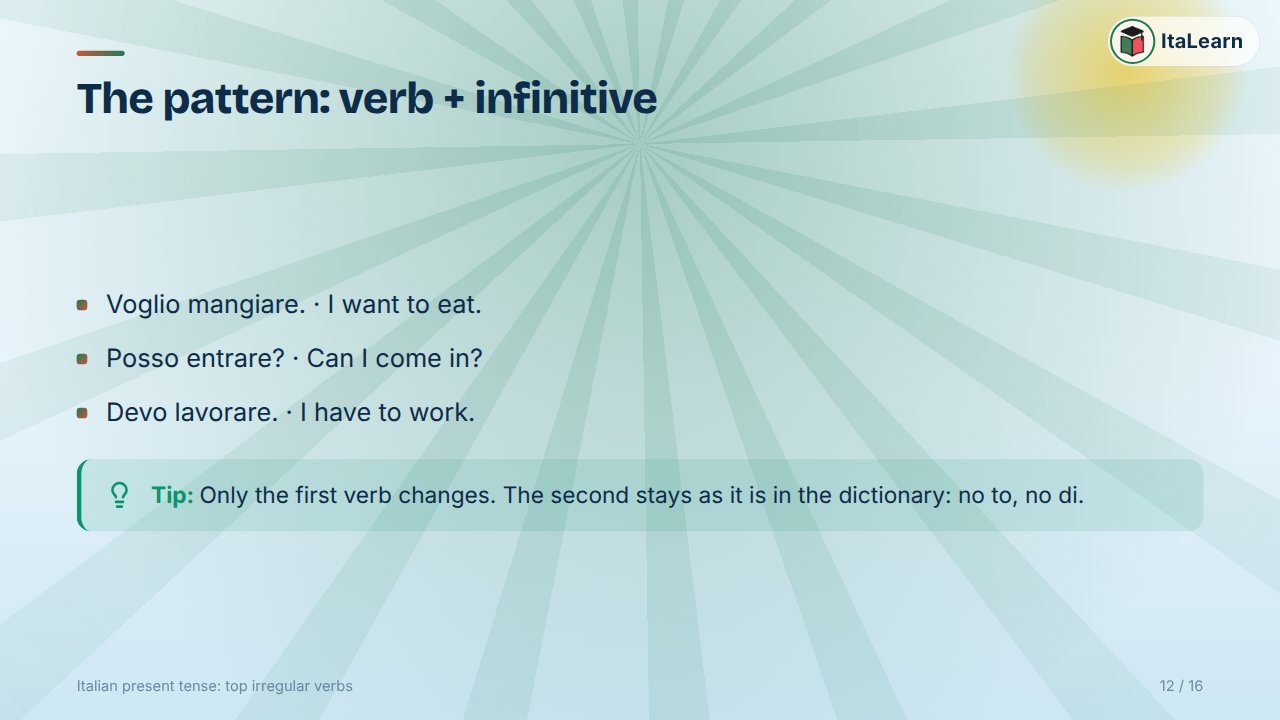
- Voglio mangiare. I want to eat.
- Posso entrare? Can I come in?
- Devo lavorare. I have to work.
Common mistakes from English
| Word for word | What Italians say |
|---|---|
| Voglio un caffè. (at the bar) | Vorrei un caffè. |
| Posso di pagare? | Posso pagare? |
| Vado a Italia. | Vado in Italia. |
All six in one conversation
Here's a short exchange between two friends, Giulia and Marco, that uses every verb from this episode:
- Giulia: Ciao Marco! Che cosa fai stasera? Hi Marco! What are you doing tonight?
- Marco: Devo lavorare fino alle sette, poi vado al bar. I have to work until seven, then I'm going to the bar.
- Giulia: Posso venire anch'io? Can I come too?
- Marco: Certo! Vieni alle otto? Of course! Are you coming at eight?
- Giulia: Perfetto. Vuoi fare una foto per Instagram? Perfect. Do you want to take a photo for Instagram?
Read it aloud once, then try changing the times and places.
Practice
Fill in the gap with the right form.
- Stasera (io) ___ al cinema. Tonight I'm going to the cinema.
- Loro ___ da Napoli. They come from Naples.
- Che cosa ___ oggi, Marco? What are you doing today, Marco?
- ___ un cappuccino, per favore. I'd like a cappuccino, please.
- Noi ___ partire presto. We have to leave early.
- ___ aprire la finestra? Can I open the window?
Answers: 1. vado · 2. vengono · 3. fai · 4. Vorrei · 5. dobbiamo · 6. Posso
Next
That's the whole present tense: regular verbs, essere and avere, and the top irregulars. Rewatch any episode in the playlist or on the series page. Next comes a new series on talking about the past: passato prossimo vs imperfetto.