
Episode 2 of the series Italian Present Tense
Italian present tense: -ERE and -IRE verbs, and the -isc- trick
5 min read

In episode 1 you learned the biggest family of Italian verbs, the ones ending in -are. Every other regular verb ends in -ere or -ire, and here is the good news: they work the same way. Find the stem, add an ending. Only the endings change, and even those are almost identical to each other.
In this episode of Italian Present Tense you will learn both groups, spot the one form that tells them apart, meet the -isc- trick behind words like capisco (I understand), and practise with everyday verbs.
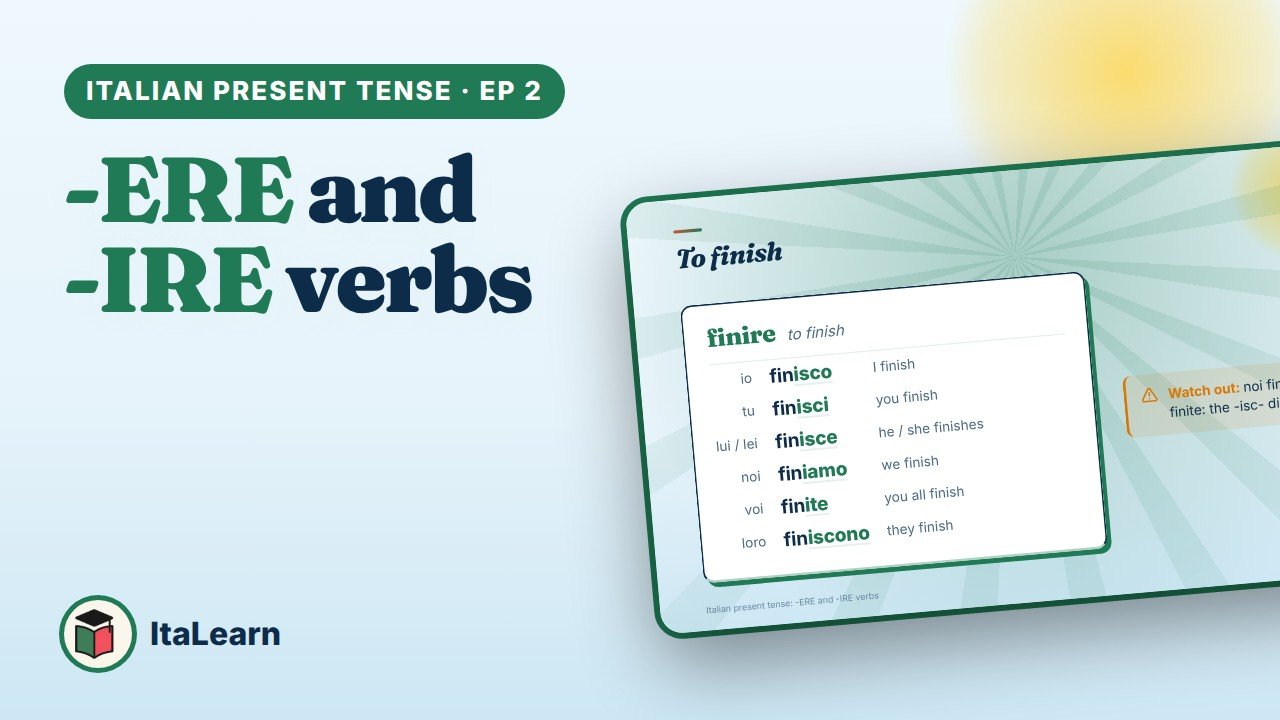
Three verb groups, one method
Every Italian verb ends in one of three ways:
| Group | Example | English |
|---|---|---|
| -are | parlare | to speak (episode 1) |
| -ere | scrivere | to write |
| -ire | dormire | to sleep |
The method is the one you already know: drop the last three letters to find the stem, then add the ending for each person.
scrivere → scriv- · dormire → dorm-
-ERE verbs: scrivere (to write)
| Person | Ending | scrivere | English |
|---|---|---|---|
| io | -o | scrivo | I write |
| tu | -i | scrivi | you write |
| lui / lei | -e | scrive | he / she writes |
| noi | -iamo | scriviamo | we write |
| voi | -ete | scrivete | you all write |
| loro | -ono | scrivono | they write |
The endings for io, tu and noi are exactly the same as in the -are group. Only three are new: -e, -ete and -ono.
-IRE verbs: dormire (to sleep)
| Person | Ending | dormire | English |
|---|---|---|---|
| io | -o | dormo | I sleep |
| tu | -i | dormi | you sleep |
| lui / lei | -e | dorme | he / she sleeps |
| noi | -iamo | dormiamo | we sleep |
| voi | -ite | dormite | you all sleep |
| loro | -ono | dormono | they sleep |
Look familiar? It should.
Spot the difference
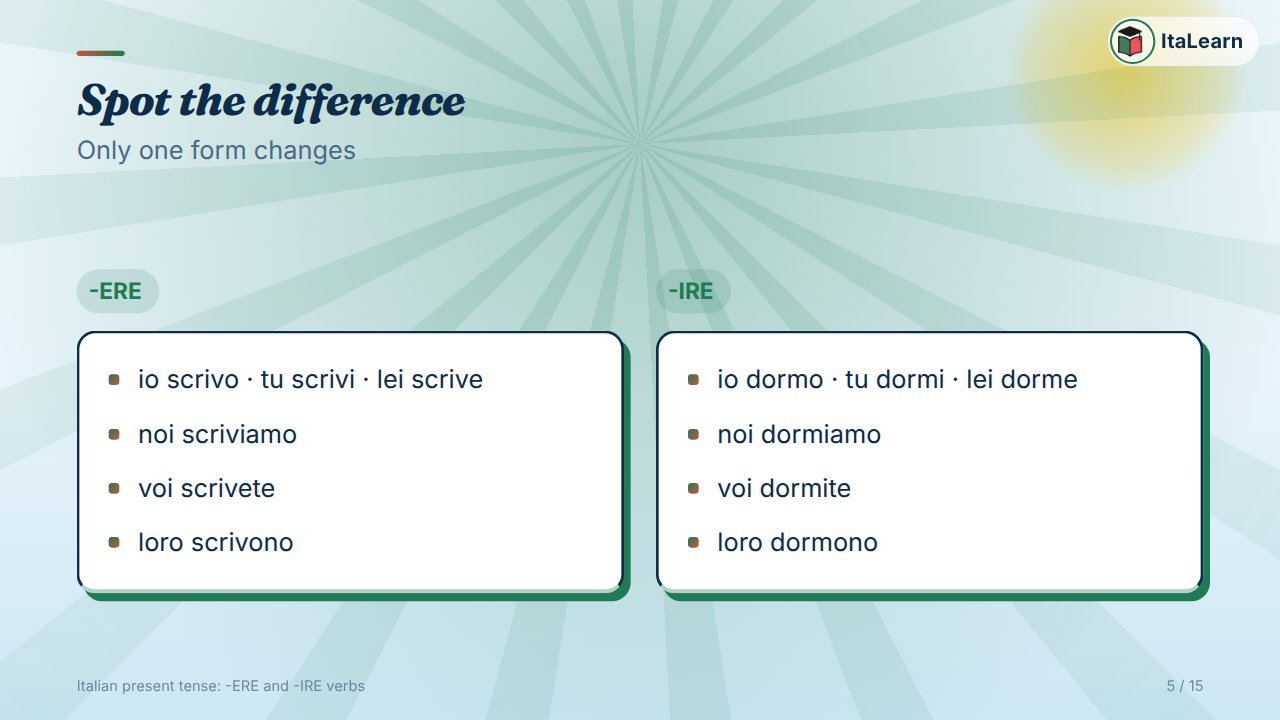
Put the two tables side by side and five of the six forms follow the same pattern. Only voi changes: the -ere group keeps its e, the -ire group keeps its i.
- Voi scrivete. You all write.
- Voi dormite. You all sleep.
Learn one table and you have practically learnt both.
Don't mix them up with -ARE
The real trap is the -are group. For lui / lei and loro, it uses an a, while the other two groups use e and o:
| -are | -ere / -ire | |
|---|---|---|
| he / she | lei parla | lei scrive, lei dorme |
| they | loro parlano | loro scrivono, loro dormono |
Everyday verbs to start with
-ERE verbs
| Verb | English | io form |
|---|---|---|
| leggere | to read | leggo |
| prendere | to take, to have (food, drinks) | prendo |
| vedere | to see | vedo |
| vivere | to live | vivo |
| chiedere | to ask | chiedo |
Prendo un caffè is how you order a coffee: literally "I take a coffee".
-IRE verbs
| Verb | English | io form |
|---|---|---|
| aprire | to open | apro |
| partire | to leave, to depart | parto |
| sentire | to hear, to feel | sento |
| offrire | to offer | offro |
And a phrase your Italian friends will love: Offro io! It's on me!
The -isc- trick
Some -ire verbs slip four extra letters, -isc-, between the stem and the ending. They do it for io, tu, lui / lei and loro, but not for noi and voi.
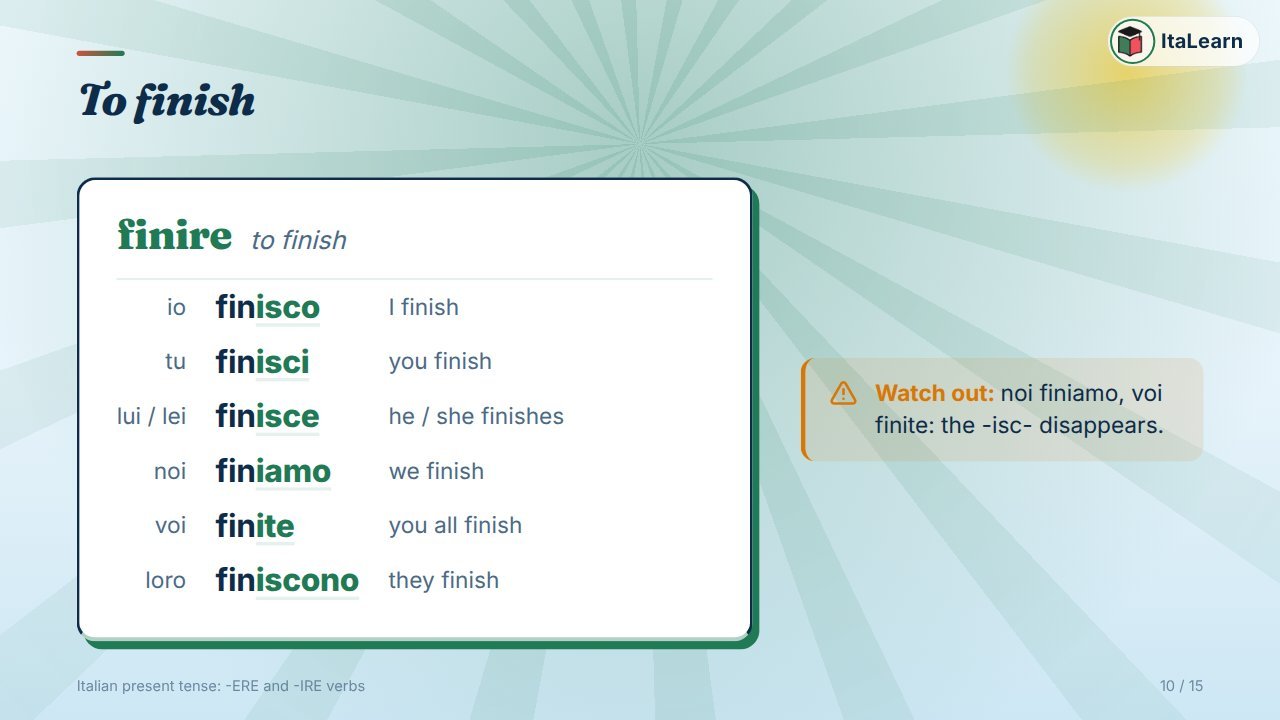
| Person | finire (to finish) | English |
|---|---|---|
| io | finisco | I finish |
| tu | finisci | you finish |
| lui / lei | finisce | he / she finishes |
| noi | finiamo | we finish |
| voi | finite | you all finish |
| loro | finiscono | they finish |
The verbs you will meet first:
- capire, to understand → capisco
- preferire, to prefer → preferisco
- pulire, to clean → pulisco
- spedire, to send → spedisco
There is no rule that tells you which -ire verbs take -isc-: dormire doesn't, finire does. Learn them as you meet them. Good dictionaries mark them, for example finire (-isc-).
Say it right
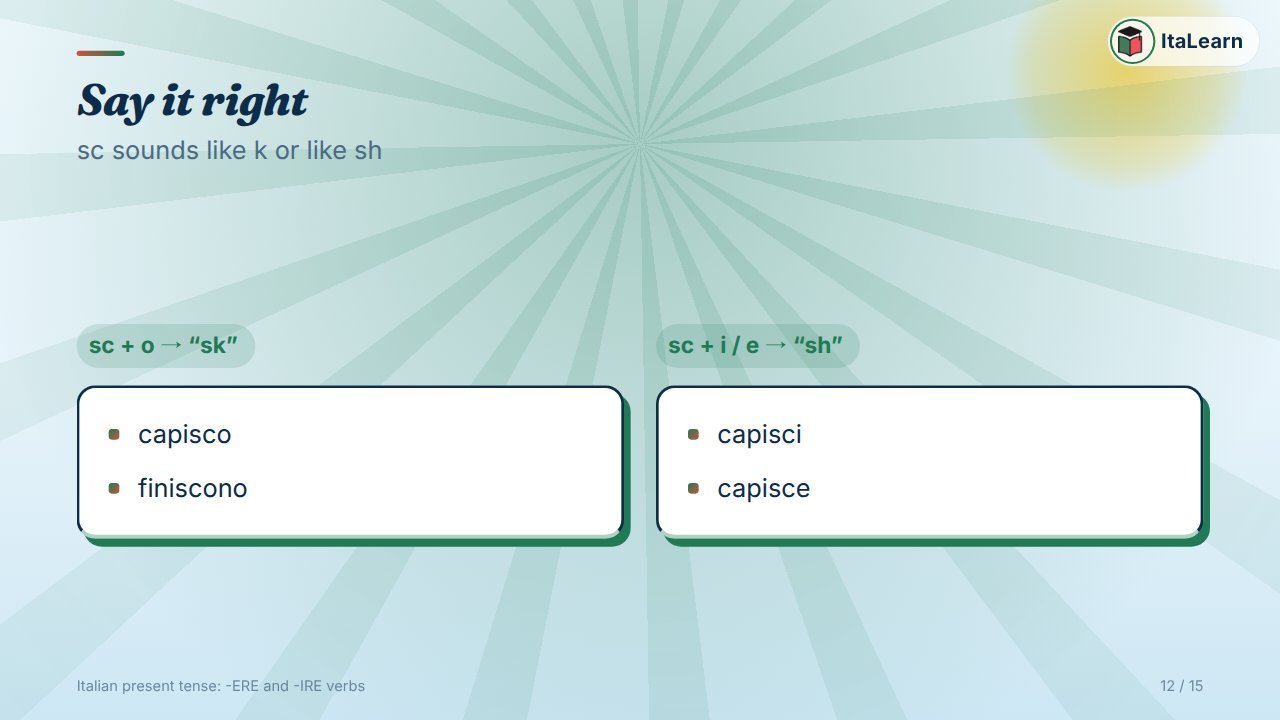
The letters sc change sound inside the same verb:
- before o: a hard "sk", as in capisco (ka-PEES-ko), finiscono
- before i or e: a soft "sh", as in capisci (ka-PEE-shee), capisce (ka-PEE-sheh)
The most useful sentence of your trip uses the hard sound: Non capisco. I don't understand.
Questions and negatives
Nothing new here: they work just like in episode 1. To make a question, keep the same words and raise your voice at the end: Leggi il giornale? Do you read the newspaper? To say "not", put non before the verb: Non dormo bene. I don't sleep well.
Three classic mistakes
- The wrong voi ending: Voi scrivite ✗ → Voi scrivete ✓
- Forgetting -isc-: Io capo ✗ → Io capisco ✓
- Adding -isc- where it doesn't go: Noi finisciamo ✗ → Noi finiamo ✓
Practice
Write or say the right form, then check the answers below.
- Tu ___ (leggere) un libro.
- Voi ___ (partire) alle otto.
- Io non ___ (capire).
- Lei ___ (preferire) il tè.
- Loro ___ (vivere) a Napoli.
- Noi ___ (finire) alle sei.
Answers: 1. leggi 2. partite 3. capisco 4. preferisce 5. vivono 6. finiamo (no -isc- with noi)
Next
In episode 3 we meet essere and avere, to be and to have, the two most important verbs in Italian. All episodes are on the Italian Present Tense page.