
Episode 1 of the series Italian Present Tense
Italian present tense: regular -ARE verbs, step by step
5 min read
If you learn one verb pattern first in Italian, make it this one. Most Italian verbs end in -are, and they all change in exactly the same way. Learn six short endings and you can use hundreds of everyday verbs, from parlare (to speak) to comprare (to buy).
In this first episode of Italian Present Tense you will learn how to find a verb's stem, the six endings of the present tense, how Italians make questions and negatives, two small spelling rules, and enough sentences to introduce yourself.
Step 1: find the stem
Every Italian verb has a dictionary form, the infinitive. For "to speak" it is parlare. To use the verb, cut off the last three letters, -are:
parlare → parl-
What is left, parl-, is the stem. It never changes. To say who is doing the action, you add an ending to the stem. That is the whole system.
Step 2: who is who
Italian has six "persons", and each one gets its own ending:
| Italian | English |
|---|---|
| io | I |
| tu | you (one friend or family member) |
| lui / lei | he / she |
| noi | we |
| voi | you all (more than one person) |
| loro | they |
One useful detail: Lei with a capital L also means the polite "you", for strangers, customers or your teacher. It takes the same verb form as "he / she".
Step 3: the six endings
Here is parlare (to speak) in full. Look at the endings in green:
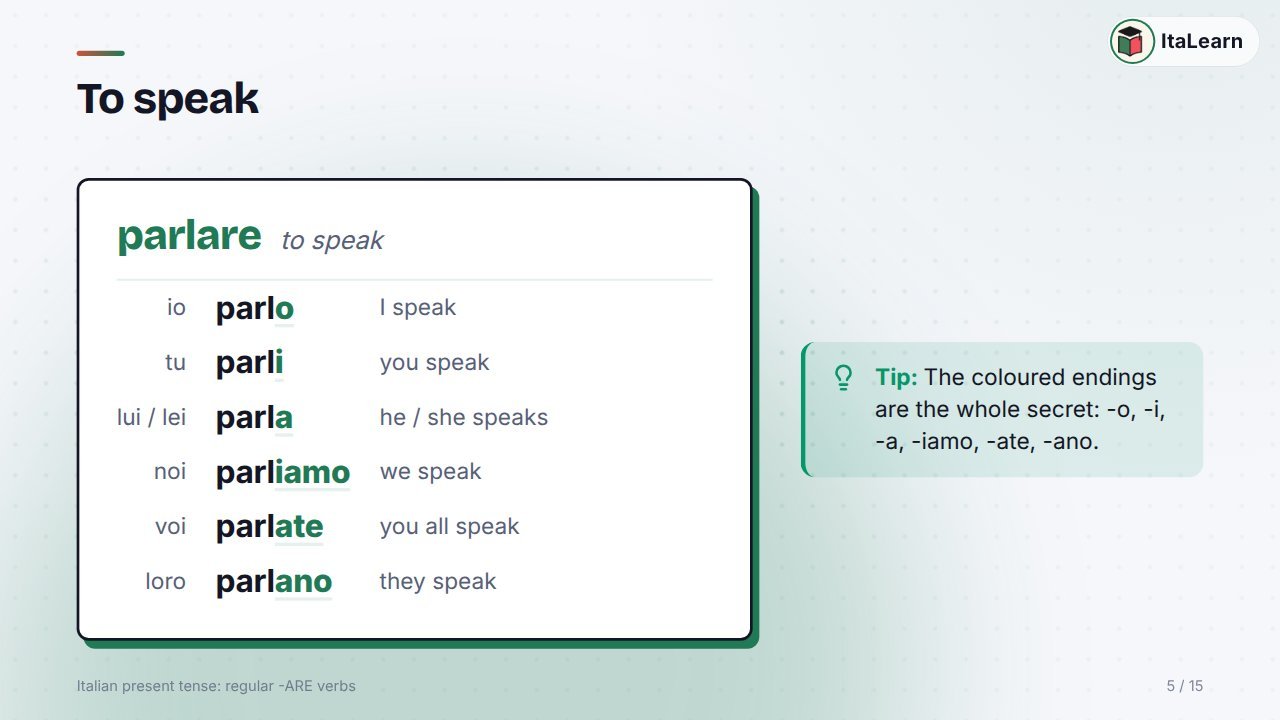
| Person | Ending | parlare | English |
|---|---|---|---|
| io | -o | parlo | I speak |
| tu | -i | parli | you speak |
| lui / lei | -a | parla | he / she speaks |
| noi | -iamo | parliamo | we speak |
| voi | -ate | parlate | you all speak |
| loro | -ano | parlano | they speak |
These six endings, -o, -i, -a, -iamo, -ate, -ano, are the same for every regular -are verb. Read them aloud a few times: the rhythm helps you remember them.
A tip on pronunciation: in parlano the stress falls on the first syllable, PAR-la-no, not on the ending. The same goes for mangiano and lavorano.
Two more verbs: to eat and to work
Mangiare (to eat) follows the same pattern, with one detail to watch. Its stem, mangi-, already ends in i, so you never write a double i:
| mangiare | lavorare | |
|---|---|---|
| io | mangio | lavoro |
| tu | mangi (not mangii) | lavori |
| lui / lei | mangia | lavora |
| noi | mangiamo (not mangiiamo) | lavoriamo |
| voi | mangiate | lavorate |
| loro | mangiano | lavorano |
Lavorare (to work) is completely regular. Try to say each form before you read it.
Italians usually drop the pronoun
In English you always say "I", "you", "we". In Italian the ending already tells you who is acting, so the pronoun is normally left out:
- Parlo italiano. I speak Italian.
- Lavori oggi? Are you working today?
- Mangiamo alle otto. We eat at eight.
Use the pronoun only to stress it or to contrast two people: Io lavoro, tu no! (I'm working, you aren't!)
Questions and "not"
Good news: both are easier than in English.
- Questions: keep the same words and let your voice rise at the end. Parli inglese? Do you speak English? There is no "do" or "does".
- Negatives: put non right before the verb. Non parlo tedesco. I don't speak German. Non mangiamo carne. We don't eat meat.
A spelling rule: -care and -gare
Verbs like cercare (to look for) and pagare (to pay) have a hard c or g sound. In Italian, c and g become soft before i, so the spelling adds an h to keep the sound hard:
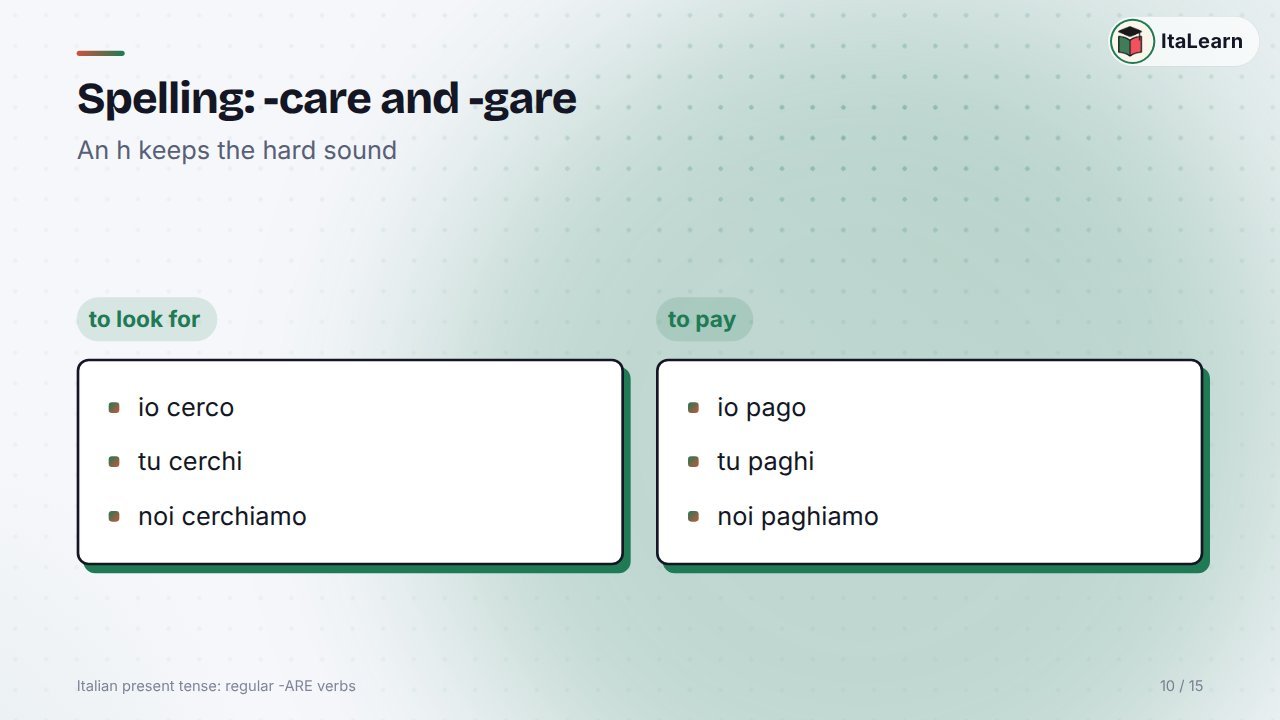
- io cerco, tu cerchi, noi cerchiamo
- io pago, tu paghi, noi paghiamo
You hear the same hard sound in every form. The h is only there to protect it.
Verbs you'll use every day
All of these follow the same pattern, so you already know their six forms:
| Italian | English | io form |
|---|---|---|
| abitare | to live | abito |
| studiare | to study | studio |
| comprare | to buy | compro |
| aspettare | to wait | aspetto |
| ascoltare | to listen | ascolto |
(Studiare behaves like mangiare: tu studi, noi studiamo, with a single i.)
Introduce yourself
With just these verbs you can already say a few things about yourself:
- Abito a Londra. I live in London.
- Lavoro in un ufficio. I work in an office.
- Studio l'italiano. I'm studying Italian.
- Parlo un po' di italiano. I speak a little Italian.
Change the city and the job, and say your own version out loud.
Three classic mistakes
- Keeping the infinitive: Io parlare italiano ✗ → Io parlo italiano ✓
- A double i: Tu mangii la pizza ✗ → Tu mangi la pizza ✓
- The wrong "they" ending: Loro parlono ✗ → Loro parlano ✓ (this group keeps its a)
Practice
Write or say the right form, then check the answers below.
- Io ___ (parlare) italiano.
- Noi ___ (mangiare) la pizza.
- Loro ___ (lavorare) a Roma.
- Tu ___ (pagare) il caffè?
- Voi ___ (ascoltare) la musica.
- Make it negative: Abito a Milano.
Answers: 1. parlo 2. mangiamo 3. lavorano 4. paghi (with the h) 5. ascoltate 6. Non abito a Milano.
Next
In episode 2 we cover the other two verb groups, -ere and -ire, plus the handy -isc- trick. All episodes are on the Italian Present Tense page.